

We’ve all heard of quantum computers—but what kind of math powers them? It's not just binary anymore—it's a blend of linear algebra, complex numbers, and probability, woven into a futuristic tapestry of computation.
🔍 What Makes Quantum Math Special?
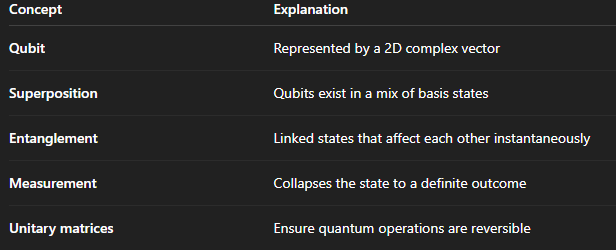
Unlike classical computers (which use 0s and 1s), quantum computers use qubits, which can exist in superposition—a state where they are 0 and 1 simultaneously.
To model this, quantum computing relies on:
Complex vector spaces
Tensor products
Unitary matrices
Dirac notation: ∣ψ⟩
🧠 Core Concepts
🔢 Key Math Tools
Linear Algebra: Matrices, eigenvalues, inner products
Probability: State collapses are governed by probability amplitudes
Hilbert Spaces: The infinite-dimensional spaces where quantum states live
🧪 Try This:
A qubit in state:
has equal probability of collapsing to 0 or 1. This is a basic Hadamard gate effect!
🌟 Final Thought
Quantum math doesn’t just push boundaries—it redefines them.
As quantum machines grow, mastering this new mathematical language becomes a superpower for the future.